
What Is a Scrub Seal? Benefits, Applications, and Ideal PCI Ranges
Jun 15, 2026
What Is a Scrub Seal? Benefits, Applications, and Ideal PCI Ranges
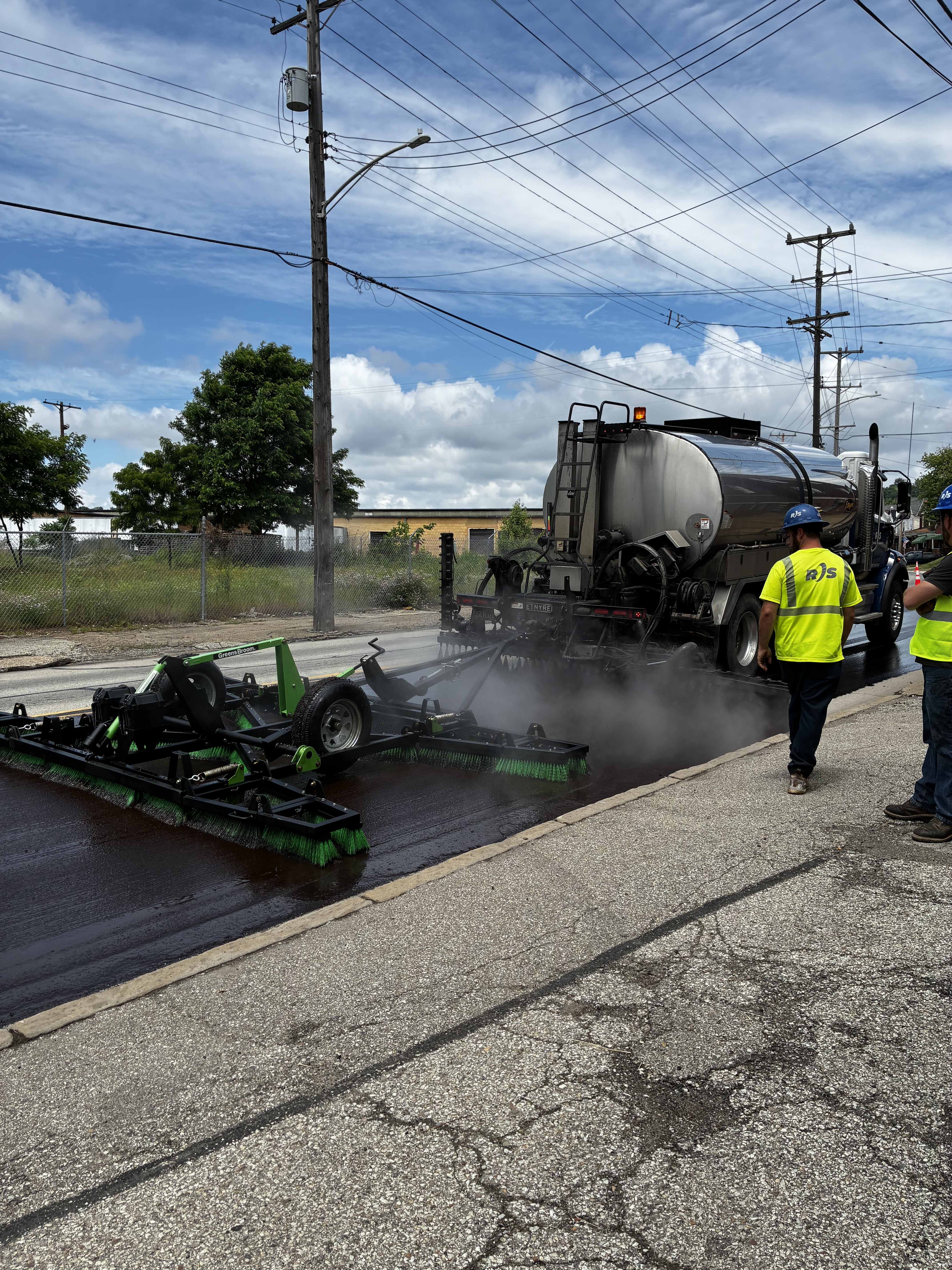
For agencies responsible for maintaining road networks, preserving existing pavement is often more cost-effective than rebuilding it. As budgets tighten and infrastructure ages, pavement preservation treatments have become essential tools for extending roadway life and delaying costly rehabilitation projects.
One treatment that continues to gain attention among Departments of Transportation (DOTs), counties, municipalities, and public works agencies is the scrub seal.
WHAT IS A SCRUB SEAL?
A scrub seal is a pavement preservation treatment that combines asphalt emulsion with aggregate to seal cracks in existing asphalt pavements. Sounds familiar, but unlike a traditional chip seal, a scrub seal uses a broom or brush mechanism to actively work the asphalt emulsion into cracks and surface imperfections before aggregate is applied. This "scrubbing" action helps fill interconnected cracking and creates a tighter seal against moisture infiltration.
The typical process includes:
- Surface preparation and cleaning
- Application of asphalt emulsion
- Mechanical brushing or scrubbing of the emulsion into cracks and voids
- Application of cover aggregate
- Rolling and sweeping to ensure proper embedment
The result is a sealed pavement surface that reduces water intrusion, slows oxidation, and helps preserve the structural integrity of the roadway.
WHY CHOOSE A SCRUB SEAL?
Superior Crack Sealing Performance
The primary advantage of a scrub seal is its ability to force emulsion into small cracks and interconnected cracking patterns that may not be effectively treated with conventional surface treatments.
By sealing these openings, agencies can prevent water from reaching the pavement structure and underlying base materials; one of the leading causes of pavement deterioration.
Extended Pavement Life
Research and field performance have shown that timely preservation treatments can significantly extend pavement service life. Scrub seals help slow the progression of cracking and surface aging, often adding several years of useful life before more extensive rehabilitation is required.
Cost-Effective Preservation
Compared to mill-and-overlay or reconstruction projects, scrub seals offer a relatively low-cost treatment option that can preserve large sections of roadway for a fraction of the cost.
For agencies managing extensive road networks, this means more lane miles can be treated within limited maintenance budgets.
WHICH ROADS ARE IDEAL CANDIDATES?
According to pavement preservation best practices and Pavement Condition Index (PCI) guidelines, scrub seals are best suited for pavements that are structurally sound but beginning to show surface distress.
Recommended PCI Range
Scrub seals are generally most effective on roads with a PCI between 60 and 80.
Within this range, pavements typically exhibit:
- Light to moderate block cracking
- Longitudinal and transverse cracking
- Minor raveling
- Surface oxidation
- Limited weathering
- Minimal rutting
At this stage, the pavement still retains adequate structural capacity, making preservation a more economical option than rehabilitation.
PRESERVING ROADS BEFORE THEY FAIL
The most successful pavement preservation programs focus on applying the right treatment at the right time. Scrub seals offer agencies a practical solution for extending pavement life, protecting infrastructure investments, and maximizing maintenance budgets.